
Ever wondered if looking at past price trends could really boost your trading confidence? Think of technical analysis indicators as your friendly roadmap that guides you through the twists and turns of market price and volume data. They break down hidden patterns and let you know when the market picks up or slows down. In this post, we'll chat about how overlay markers (tools that sit atop your basic price chart) and oscillator markers (tools that help spot when the market might be overbought or oversold) work to clear away the daily market chatter. These handy tools give you the clear insight you need, making your trading moves smoother and more confident.
How Technical Analysis Indicators Assess Market Conditions

Technical analysis tools look only at past price and volume data. They don’t fuss over company fundamentals or big-picture trends. Instead, they help traders spot trends, pinpoint support and resistance levels, and catch shifts in momentum. Imagine a chart where past prices join together in a smooth, steady line, kind of like how a well-drawn map guides you on a journey.
There are two main types of these indicators. The first group, called overlay indicators, plots trend lines directly on the price chart so you can compare them in a single glance. Think about moving averages or Bollinger Bands. For example, if a blue moving average crosses above a red one, it might hint at prices rising. Ever notice how a simple moving average can smooth out the daily noise and reveal a clearer picture of the market's long-term rhythm?
The second group is oscillator indicators, which measure momentum within a set range. Tools like the Relative Strength Index (RSI) or MACD (which stands for Moving Average Convergence Divergence, a tool to gauge momentum by showing how different averages converge or diverge) let you know when the market might be too high or too low. Picture a speedometer: when the RSI needle pushes past 70, it can be a little red flag, much like a warning light on your car dashboard.
Remember, these methods don’t predict the future with perfect certainty. They simply offer a structured look at historical trends so you can make smarter moves. For more on this approach, check out the overview on what is technical analysis in investment. Together, these overlay and oscillator strategies give traders a blend of insights, making them feel a bit more secure about their decisions in the market.
Overlay vs Oscillator Chart Indicators

Overlay indicators draw trends right onto your price charts. Think of them like a simple line tracing a stock’s ups and downs, making it easy to spot where the price has been. Moving averages and Bollinger Bands are two common examples of this type of tool.
Oscillator indicators, on the other hand, keep track of market momentum within set boundaries. Tools like RSI (Relative Strength Index – a quick check to see if trading is too high or too low) and MACD (Moving Average Convergence Divergence – a tool to spot changes in trends) alert you when the market might be overbought or oversold. When one of these tools signals that prices are nearing an extreme, it’s a hint that market conditions could be shifting.
Using these indicators together can give you a clearer picture. For instance, if an overlay indicator confirms a rising trend while an oscillator shows that momentum is slowing, you might want to be cautious and prepare for a possible price turn.
| Indicator Type | Examples | What They Show |
|---|---|---|
| Overlay Indicators | Moving Averages, Bollinger Bands | Chart trends and price level patterns |
| Oscillator Indicators | RSI, MACD, Stochastic | Momentum and when prices hit extremes |
Moving Averages and Trend Signal Indicators

Simple moving averages, or SMAs, work by calculating the average price over a chosen period. They smooth out everyday price bumps so you can see the bigger trend more clearly. Exponential moving averages, or EMAs, work similarly but put more emphasis on recent prices. This extra weight lets EMAs pick up quick changes faster.
Moving average crossovers compare a fast-moving average with a slower one. When the fast average moves above the slow one, it might signal an upward trend, often called a golden cross. And if it drops below, that could hint at a downward trend, sometimes known as a death cross. These crossovers give traders a straightforward way to see how strong the trend is, helping build confidence in trading decisions.
Adaptive moving algorithms mix these ideas by adjusting to what’s happening in the market at the moment. They act like a smart sensor for trend strength, serving both as a clear visual guide and a solid tool for deciding when to enter or exit a trade.
| Indicator | Calculation Type | Typical Periods | Trading Application |
|---|---|---|---|
| SMA | Average price over set periods | 20, 50, 200 days | Smoothing price data |
| EMA | Weighted average emphasizing recent prices | 12, 26 days | Responsive trend signals |
| Crossover | Comparison of fast and slow moving averages | Varies based on strategy | Entry/exit signals |
These moving average tools give traders a hands-on view of market movements. They make trend shifts easy to spot, blending clear data with a friendly, step-by-step approach.
Momentum Oscillators for Entry and Exit Signals
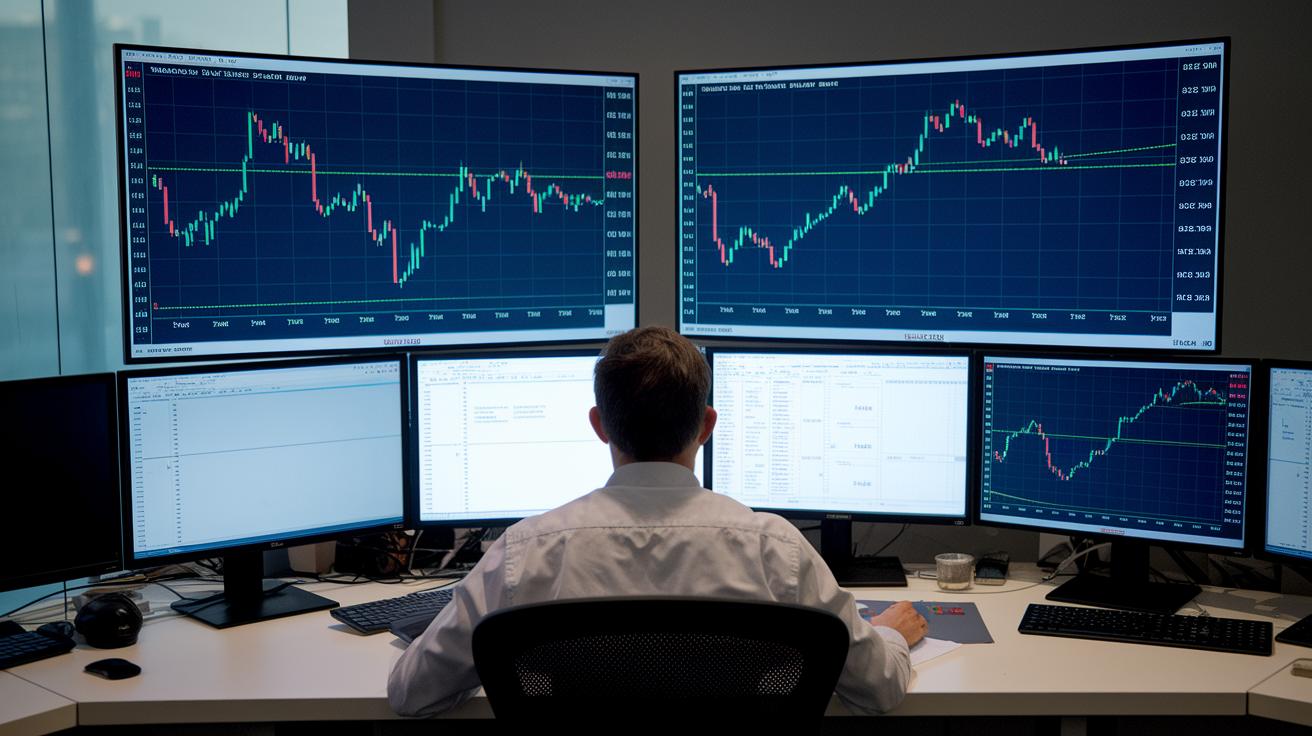
Oscillator tools like RSI (Relative Strength Index, which tells you the speed and change of price movements on a 0-100 scale), MACD (which compares different moving averages to spot trends), and the stochastic oscillator (which looks at recent price extremes) give us a clear read on market energy. In this section, we hone in on using these tools to decide exactly when to jump in or get out of a trade.
RSI is all about momentum. When it moves above 70, it hints that the market might be getting overheated, perhaps it’s a good time to consider selling. When it slips under 30, the market might be dipping low, opening a door to buy. Imagine it as a simple meter: high readings suggest caution, and low ones suggest opportunity.
MACD, on the other hand, compares two averages, typically a fast one (default 12) and a slow one (default 26), to track momentum. A switch where the MACD line climbs above its signal line (normally set at 20) can point to a buying moment, while a reverse switch might mean it’s time to sell. Think of it like a seesaw: a tip one way nudges you to buy, and the other way, to sell.
Then there’s the stochastic oscillator. It compares the latest closing price to the range of prices over a set time period. Readings over 80 can signal that the asset might be overbought, and those under 20 might mean it’s oversold. It’s a handy little tool for fine-tuning your timing, much like noticing the quickening or slowing of a heartbeat.
| Indicator | Parameter | Value/Threshold |
|---|---|---|
| RSI | Range | 0 – 100 (Overbought above 70, Oversold below 30) |
| MACD | EMAs | Fast EMA: 12, Slow EMA: 26, Signal line: 20 |
| Stochastic Oscillator | %K and %D | %K: 14, %D: 3 (Overbought over 80, Oversold under 20) |
Tuning these settings helps clear up the picture, so you know exactly when to make your move. It’s all about cutting through the noise and making decisions with clear, steady insight.
Volume and Volatility Indicators

OBV, or On-Balance Volume, is a handy tool that keeps track of net volume flow. On days where prices move up, it adds volume, and when prices drop, it subtracts volume. This lets you spot the balance between buyers and sellers, helping you catch shifts in how strong the trend might be.
The A/D Line, short for Accumulation/Distribution Line, works in a similar way by mixing price and volume data. Think of it as a line that shows if more shares are being collected or spread out over time, pointing to a trend’s confirmation or even a potential reversal.
VWAP, which stands for Volume Weighted Average Price, finds an average price throughout the day, but with a twist, it weighs the average by trading volume. In simple terms, it acts like a fair referee, telling you whether a stock is trading at a good value during the day. Traders often lean on VWAP to decide the best times to enter or exit a trade.
Bollinger Bands add another layer by comparing the current price with past volatility. They set boundaries using measures like percent-b and bandwidth, which can alert you when prices stray too far from what’s normal. It’s like getting a heads-up when the market feels unusually hectic or too calm.
Standard deviation is a basic gauge that shows how far prices can wander from the average. In plain terms, it gives you a feel for whether the market is acting wild or staying steady. By using these volume and volatility tools together, you get a clearer picture of the market’s everyday action, making your trading moves more informed.
Integrating Technical Analysis Indicators for Optimized Trading Signals

Let me tell you about a trader who upped his game by blending familiar tech tools in busy, unpredictable markets. He played around with his RSI settings (a gauge for spotting overbought or oversold conditions) and fine-tuned Bollinger Bands (a method that shows market volatility) by comparing them to past trends. This mix not only kept wrong signals at bay but also spotlighted key market turning points as they happened.
Traders these days use advanced backtesting to play out different market scenarios with loads of historical data. For instance, one trader dug into ten years of digital asset trends and experimented with various MACD settings, a tool that tracks momentum, to perfect his approach. Ever notice how a little tweak can clear up all the noise? By reviewing past data, he was able to home in on steady signal patterns and make sharper trading decisions.
Here are a few key points to keep in mind when combining these indicators:
| Tip | What It Means |
|---|---|
| Test settings on historical data | Adjust your tools based on past market behavior |
| Run sensitivity tests | See how different changes perform in various market conditions |
| Mix refined indicators | Combine adjusted tools to catch fast market shifts |
For more techniques and detailed case studies, check out our insights on investment analysis techniques at nftcellar.net?p=430.
Final Words
In the action, the article explored how technical analysis indicators use past price and volume data to measure market trends and momentum. We reviewed overlay tools that draw trend lines and oscillators that gauge momentum shifts. Moving averages and volume indicators gave us clear signals for entry and exit points. Integrating these tools can help shape a resilient digital asset portfolio. It’s encouraging to see simple, effective strategies making a positive impact on investment decisions. Keep applying these insights with confidence and enthusiasm.
FAQ
Where can I get a technical analysis indicators PDF or free download?
The technical analysis indicators PDF provides a guide on using historical price and volume data and is often available on reputable financial sites offering free downloads for learning market trends.
What are some top trading indicators and a technical indicators list?
The top trading indicators and technical indicators list generally feature moving averages, RSI, MACD, and Bollinger Bands, tools that help traders spot trends, gauge momentum, and identify reversals.
What are the 4 types of technical indicators?
The 4 types of technical indicators include trend-following, momentum, volume, and volatility indicators, each using past market data to provide insights into price direction and strength.
Which technical analysis indicator is considered the most accurate or the best?
The most accurate or best indicator depends on strategy, though many traders favor RSI and MACD for their clear signal patterns and ease of spotting market momentum and shift points.
What are the three rules of technical analysis?
The three rules of technical analysis focus on identifying market trends, noting support and resistance levels, and confirming signals by cross-checking with other indicators for more reliable trading signals.
What are the big 3 indicators in technical analysis?
The big 3 indicators typically include moving averages, RSI, and MACD, which when combined, help traders monitor trends, assess momentum, and decide on entry or exit points in the market.
What are the 4 pillars of technical analysis?
The 4 pillars of technical analysis involve examining trends, determining support and resistance, measuring momentum, and analyzing volume, each providing a different layer of market insight for informed decisions.
What technical analysis indicators work for forex trading?
Technical analysis indicators that work for forex include oscillators like RSI, trend tools like moving averages, and volatility measures like Bollinger Bands, all designed to fit the unique rhythms of currency markets.
Which platforms offer these technical indicators, such as TradingView, Binance, Thinkorswim, Webull, NinjaTrader, and eToro?
Trading platforms like TradingView, Binance, Thinkorswim, Webull, NinjaTrader, and eToro integrate a wide range of technical analysis indicators that empower traders to monitor trends and manage trades with accessible, real-time tools.
